RSS
Showing posts with label Dakwah. Show all posts

Friday, March 21, 2014

Pendakwah Conan; Pendakwah, Konon.


Bismillahirrahmanirrahim.
Assalamualaikum wbt.

1. Persoalan ilmu adalah persoalan yang sangat penting dalam ajaran Islam.

2. Sebagai muqaddimah, ingin saya berceloteh sedikit tentang bagaimana kita melihat tiga makhluk Allah SWT yang berbeza (yakni Nabi Adam AS, para malaikat 'alayhim as-salam dan iblis la'natullah) serta kaitannya dengan soal ilmu.

3. Jika kita teliti dalam Surah Al-Baqarah, dalam Al-Quran pada muka surat 6 (bermula ayat 30), ada kisah dan pengajaran yang sangat menarik dan penuh iktibar.

4. Dengan asbab ilmu, Nabi Adam AS, dan manusia umumnya, telah dimuliakan melebihi para malaikat. Malah manusia (atau insan) adalah sebaik-baik ciptaan (rujuk Surah At-Tin, ayat 4).

5. Di muka surat 6 ini (diceritakan), para malaikat akur pada ilmu Allah SWT Al-'Alim, bahawa mereka hanya tahu apa yang Allah SWT ajarkan kepada mereka, sebagaimana doa yang kita selalu dan lazim baca.


6. Mereka tidak dapat menjawab apabila ditanya tentang nama-nama benda ciptaan Allah 'azza wajalla, sebaliknya apabila ditanyakan kepada Nabi Adam AS, Nabi Adam AS tahu nama-nama benda itu (kerana diajarkan oleh Allah SWT).

7. Sungguh, dengan asbab ilmu, Allah SWT menjadikan Nabi Adam AS dan cucut-cicitnya mulia.

8. Jika kita bandingkan dengan iblis yang dilaknat oleh Allah SWT, makhluk ini dikurniakan banyak ilmu, Bahkan iblis suatu ketika dikatakan ahli ibadah yang hebat, sehingga tiada bahagian permukaan di muka bumi ini yang tak pernah menjadi tempat sujudnya.

9. Namun lihatlah dalam muka surat yang sama, diceritakan apabila Allah SWT berfirman agar semua tunduk hormat kepada Nabi Adam AS, iblis dengan sombong, bongkak dan takbur ingkar akan arahan Allah SWT, maka jatuh kafirlah ia.

10. Inilah siren merah buat kita semua. Bahawa ilmu yang asalnya memuliakan itu, boleh saja menghinakan kita dengan asbab sombong, bongkak dan takabbur seperti iblis.

11. Tidak mahukah kita mengambil pengajaran?

DETEKTIF CONAN


12. Kita semua mencari ilmu untuk berdakwah, yakni mengajak orang mendekati Islam.

13. Justeru ingin saya ambil peluang ini untuk merakamkan sedikit renungan peribadi (personal contemplation), agar menjadi nasihat dan peringatan buat diri dan rakan-rakan pembaca yang dikasihi.

13. Sheikh Hamza Yusuf hafizhohullah pernah bermadah, "Agama sepatutnya menyatukan kita semua. Jika agama itu tidak begitu, maka ia bukan daripada Allah SWT, ia daripada sesuatu yang lain!"

14. Beliau juga menyebut tentang penyataan Imam Ali radhi-Allahu 'anhu yang cukup mendalam maknanya, bahawa "bersatunya orang-orang yang tidak suci itu lebih baik daripada orang-orang suci yang tidak bersatu."

15. Kita diajar bahawa bila berdakwah kepada orang bukan Islam, kita bukan nak kata yang kita lebih baik daripada mereka, tapi kita ada sesuatu yang lebih baik untuk mereka (yakni Islam).

"I am not saying that I am better than you, but I have something better for you i.e Islam."

16. Di situ, kita mensabitkan kemuliaan itu pada Islam, dan bukannya pada diri sendiri. Justeru, jika seorang bukan Islam masuk Islam, bahkan dia boleh menjadi jauh lebih baik daripada kita.

17. Namun patutkah, dalam kita berdakwah atau berjuang atas nama Islam, kita memperlekeh dan memburuk-burukkan sesama Muslim? Apatah lagi memperlekeh-lekehkan golongan 'alim ulama' zaman dulu dengan anggapan bahawa mereka sudah tidak relevan dalam zaman dan cabaran baru sekarang?

18. Kita mempromosikan 'kumpulan' kita, bukan Islam.

19. Lebih buruk lagi, kita promosi diri sendiri, biar orang datang kepada kita, bukan kepada Islam.

20. Alangkah cantiknya ciptaan Allah SWT yang menciptakan mata hati yang letaknya di bahagian dalam, serta menjadikan mata zahir (naked eye) itu tempatnya di luar.


21. Justeru, orang yang hanya menggunakan mata zahir, hanya melihat ke luar, dan mencari-cari kesalahan orang.

22. Orang yang menggunakan mata hati pula, sentiasa melihat ke dalam, muhasabah diri sendiri dan melihat kesalahan orang lain itu sebagai satu tanggungjawab ke atasnya untuk menegur dengan KASIH SAYANG, atau sebagai salah satu peringatan daripada Allah SWT, bahawa dia sedang melakukan kesalahan yang sama.

23. Golongan pertama tadi, memandang dengan pandangan seorang yang sedang menggunakan teropong atau mikroskop untuk mencari sejelas-jelasnya apa yang ada di luar.

24. Golongan kedua pula, yang melihat dengan mata hati, melihat sekelilingnya ibarat satu cermin yang besar, kerana di situ dia dapat kenal dan ubah dirinya, kerana dari situ dia melihat dirinya sendiri.

25. Tidaklah dapat kita melihat dengan mata hati, jika ia buta. Dan tidaklah ia buta, melainkan terlalu banyak penyakit hati yang membutakannya. Wal 'iyazubillah.

26. Habib Ali Al-Jufri hafizhohullah dalam satu sedutan ceramah beliau menyentuh tentang isu keikhlasan dalam menuntut ilmu.

27. Ada orang pada hari ini, lebih banyak ilmu agama yang dia pelajari, lebih banyak dia menghukum orang, lebih keras dia jadi, dan kerjanya tidak lain melainkan untuk menjauhkan orang daripada agama.

28. Sheikh Hamza Yusuf hafizhohullah mengingatkan, bahawa pintu Allah sentiasa terbuka (untuk orang bertaubat), maka siapa sahaja yang menutup jalan-jalan ini, maka dia adalah shaytan. Wal 'iyaa zubillah.

29. Saidina Umar Al-Khattab radhi-Allahu 'anhu pernah menyebut bahawa yang paling ditakuti olehnya terhadap ummah ini adalah seorang yang munafiq tetapi banyak ilmunya.

30. Apabila ditanya oleh sahabat yang lain, Saidina Umar menjelaskan bahawa golongan ini adalah orang yang banyak ilmu pada lidahnya, tapi jahil pada hatinya.

31. Muhasabahlah pada diri kita. Adakah setiap ilmu baru yang kita peroleh akhirnya mendekatkan diri kita kepada Allah SWT? Adakah dengannya kita semakin takut dan bimbang?

32. Tidakkah kita khuatir bahawa Allah SWT tidak menerima satu pun amalan soleh kita kerana akhlak buruk kita, tetapi memuliakan amalan seorang hamba Allah SWT yang biasa sahaja tetapi berakhlak mulia?

33. Perhatikanlah. Jika dengan ilmu agama, hati kita menjadi lebih keras, jiwa kita menjadi semakin kosong, justeru ia satu tanda bahawa ilmu itu bukan datang daripada (ajaran) Nabi Muhammad SAW, rahmat buat sekalian 'alam.

34. Sebab itulah saya kiaskan (sebagai tajuk artikel ini) dengan cerita kartun Detektif Conan, yang tugasnya adalah mencari-cari siapakah yang bersalah. Bukan itu yang sepatutnya menjadi tugas kita seorang pendakwah.

"....dan janganlah kamu mengintip dan mencari-cari aib dan kesalahan orang dan janganlah kamu mengumpat..."
(Surah Al-Hujurat, ayat 12)

35. Akhir kata, mulai hari ini, jika kita menghadiri majlis ilmu, banyak-banyakkan istighfar buat diri dan penceramah dan jika penceramah ini kerjanya hanyalah mem'bahan' orang, atau juga di laman sosialnya, tinggalkanlah dia dan doakanlah dia.

36. Daripada akhlak yang buruk itu, akan terpalit pada kita juga, dan jika tidak cepat, lama-kelamaan akan terkena tempias juga.

37. Banyak-banyakkan berdoa dan banyak muhasabah diri. Jika kita sibuk memperbaik diri, insya Allah tidak akan ada 'waktu lapang' untuk mencari kesalahan orang.

38. Bukankah malang jika kita berasa gembira dengan kesalahan Muslim yang lain, padahal kesalahan orang lain tak menjadikan kita betul. Kita betul bila memang ia betul di sisi Islam, tak ada kena mengena dengan kesalahan orang lain.

39. Moga Allah SWT menyatukan hati-hati kita. Moga hati kita dibasahi dengan rahmah, jiwa kita disirami dengan hikmah, dan hidup kita penuh ketenangan dan sakinah.

40. Ameen. Allahumma ameen.

Read more "Pendakwah Conan; Pendakwah, Konon."

Sunday, March 17, 2013

A Dialogue (Part 3)


46. In the last episode, we have dealt with short yet important arguments on the proof of God's existence.

47. What comes next is to ascertain that this God that exists is none other but Allah SWT.

48. I am going to put it this way. First, I shall bring forward the general idea on how do we decide who is God.

49. After that, we shall see from the Quran (through its existence and its arguments) that the God must not be other than Allah SWT.

50. So we have three things here. First, the general idea, then the second, proof from Al-Quran's existence and thirdly, the arguments by the Quran.

51. Firstly, the general idea is simple. If God exists, then He must act justly by providing signs to His creations. This is so that the creations will not have any valid excuse when God were to judge either to punish them (if they deny God) or save them (if they accept and submit to God).

52. Among the signs He has provided are through revelations (wahy).

53. Major religions such as Islam, Christianity and Hinduism, to name a few, have their own scriptures, believed to be the words of God (or at least the words that speak on behalf of God).

54. For instance, Islam with the Al-Quran and the Christianity with the Bible (Old and New Testaments).

55. Common sense will tell us easily, that the most important aspect of a religion is its concept of God.

56. Hence, while all above religions believe in God/gods, it is now necessary to provide a set of criteria or yardstick taught in each religion, to prove who is and who is not God. The most reliable source for this is definitely the scriptures of each religion.

57. As I am going to represent my beloved deen, Islam, I will explain the concept of God in Islam, and in doing so, will make fine comparisons between Allah as God with the God believed by the Christians, Jesus Christ being one of them (so that we can test how the criteria of God works).

58. However, as mentioned earlier, I will firstly speak in brief about the existence of Quran itself as a proof that Allah is the God, One and Only.

59. This is a very simple argument.

60. Firstly, just to get things clear here, Al-Quran is not the words of Prophet Muhammad SAW, but are the EXACT words of Allah SWT (revealed through him to the whole mankind). Insya Allah (God willing), I will elaborate more on this in the other upcoming episode, but suffice to say now, that the words of Muhammad SAW, is called ahadith (plural of hadith) instead.

61. Now, going back to the argument, Al-Quran has mentioned explicitly that it was revealed by Allah SWT and Allah will protect it until the end of time.

62. Now, imagine this. If all religions were to reach a global consensus, that today we shall burn and destroy all the scriptures and textual documents of religions (Quran, Bible, Veda etc.) including those on the net without any trace or backup copy whatsoever, guess what will happen?

63. Within only few days, only the Quran will come back to its absolute original form, with no alteration at all, not even an alphabet!

64. And why is this?

65. Because Al-Quran (which is in Arabic language) is the only book memorized in totality by many Muslims worldwide!

66. We have children as young as 5 years old (if not younger) who memorizes the Quran from cover to cover, and in addition to that, many of them don't even speak (or understand) Arabic language!

67. This is a guarantee from Allah (in Surah Al-Hijr, aayat no.9) that the preservation of Quran will last!

68. It has been more than 14 hundred years now, yet it has not been altered, not in the slightest!

(The case for Bible is significantly different, because even the Bible scholars would agree that not only Bible has gone through so many changes (addition and deletion) here and there throughout the course of its long history, in fact now there are so many different versions of Bible!)

69. The fact that Al-Quran explicitly mentions Allah as the One and only true God, and the fact that its preservation is impossible without permission (and work) of God, we have now come to the end of our first premise, that is, Al-Quran through its existence is a proof that Allah is the God.

70. Now, this last point may be the most interesting part to analyse together.

71. In the Quran, the 112th chapter is called Surah Al-Ikhlas.

72. It is one of the shortest Surah in it, nevertheless carries huge weight and significance when it comes  to the concept of God in Islam.

73. In fact we shall now analyse the 4 criteria of God it outlines from its short yet eloquent four verses.

74. The verses explain that Allah is the God, and then beautifully continue with the attributes of Allah as God (hence the criteria of God in Islam) which is fulfilled by only Allah and none others.

75. For comparison, now let's take Jesus Christ and put him on test (whether he fulfills the criteria to be God).

76. Before I continue though, it's necessary to mention here that  Jesus Christ (in Arabic, Isa) is regarded as a great prophet by us Muslims.

77. This comparison is in no way attempting to condemn him. In reality (for the Muslims), elevating him as God, is something he himself (Jesus) will despise and disprove of, hence a true form of insult instead!

78. The first verse says that God must be One and Only. Christians believe that Jesus is the Son of God, apart from The Father God and the Holy Spirit (in a concept called Trinity). Hence, the fact that now we have more than one God, we will say that Jesus is not a God.

79. The second verse refers to the absolute and eternal nature of God i.e God has neither beginning nor ending. Muslims and Christians alike believe that Jesus was born by Mary (in Arabic, Maryam).

80. However, only the Christians believe that Jesus died.

81. The fact that he was born means that he has a beginning. And the fact that he dies means that he also has an ending.

82. Therefore, according to the second criteria, Jesus must not be God because he begins and ends (which makes more sense if we consider him a human being, but a prophet, as believed by Muslims).

83. Thirdly, God must not beget nor is he begotten. What this means is that a God must not be born or that he gives birth. Jesus was born. Hence, he is not a God.

84. The last verse, hence the last criteria suggests that God is not God if he is the same (or possess any similarity with His creation).

85. Jesus obviously appears to be in the form of a man during his lifetime, which again makes him not a God, but as believed by the Muslim, more logically a prophet.

86. With a rather long discussion above, I shall put an end to this part here. 

87. Let me end with this testimony. I firmly bear witness that there is no God except Allah SWT, He is One and Only, and Muhammad SAW was his Messenger.

(To be continued in Part 4)

"Or have they taken for worship (other) gods besides Him (Allah)? Say: Bring your proof. This (the Quran) is the Reminder for those with me and the Reminder for those before me. But most of them know not the Truth, so they are averse."
(Surah Al-Anbiya, aayat no.24)


Read Part 2 here
Read more "A Dialogue (Part 3)"

Tuesday, March 12, 2013

A Dialogue (Part 2)

(Part 2)

20. Atheist and Agnostic are different.

21. Atheists reject God, while Agnostics claim that there is no way we can prove the existence of God.

22. Responding to Atheists, as Muslims, we believe that rejecting the existence of God is similar to rejecting the existence of ourselves!

23. As for the Agnostics, maybe they do not even know whether they themselves exist.

24. Some other people may go to an extent asking where is God (if He really exists).

25. Imam Al-Ghazali RH, a great Muslim scholar has answered this question by telling us, that we do not even know where exactly we are in the universe, yet we ask where is God? Truth is, we can't even draw a complete map of the whole universe, how then do we expect to capture God with our naked eyes?

26. In this Part 2, I will be dealing with the explanation on how do we believe that God exists. Some of the explanation are ones I already shared with the guy I had a dialogue with, while some others are additional information for you guys here.

27. Firstly, let us all ponder upon this excellent question posed by Allah SWT in the Quran.

".....Were they created from NOTHING? Or were they creator themselves? Or did they create the heaven and the earth? Rather, they are not certain."
(Surah At-Tur, ayat 35-36)

28. Allah SWT challenges us with this question, which if we think about it, are important questions we have to ask before we ask whether God exists.


29. Is it possible that we are created from nothing? Exactly not. At least we would logically think that we were created from clay, the earth, which is true enough (as we are from Adam, and Adam was from the soil, according to Quran itself), but who created the earth, and who molded the earth into something called human being in the first place?

30. Did the earth suddenly rearrange itself and become us? No, there must be God. He created us.

31. People would then ask, so in that case, who created God?

32. Nabi SAW through his saying (hadith) has taught us that such question is a trick from shaytan, the devil.

33. The way we respond to that question is by saying (and firmly believe) aamantu billaahi warosulih (which means, I believe in Allah and his messenger).

34. Nevertheless, insya Allah with His permission, we can look at this question in a number of ways which may help cater to the reasoning of our mind insya Allah.

35. Firstly, God is uncreated. If He is created, then He is not God.

36. Saying that God is created is like attempting to draw a circular triangle, or a triangular circle.

37. It doesn't make any sense. A circle can't be triangular in shape. The same way, if we have a triangle, then its shape can't be circle.

38. Secondly, is the implication of asking the question. If say, for the sake of argument, God is created (wal 'iya zubillah), and the creator is A, we can still ask, who then, created A?

39. Say, B created A. Then the question continues, who created B then? Say, C created B.

40. So who created C then? Can you see where this is going? It becomes more and more absurd.

41. Therefore, it is more rational to think that God is uncreated. And the fact that He exists, without any need from others, without any need to be created, is a proof that He is God.

42. Lastly, going back to the Quranic verse aforementioned above, it is asked upon us, that, did we create ourselves?

43. If that is so, then we need to exist first to create ourselves. But how do we exist before we were created?

44. Another absurdity indeed. May Allah always guide us insya Allah.

45. Next, as we are now pretty certain that God exists, why must that God be Allah? Why can't we believe in other God/Gods?

(To be continued in Part 3)

Read Part 1 here
Read more "A Dialogue (Part 2)"

Monday, March 4, 2013

A Dialogue (Part 1)


Bismillahirrahmanirrahim.
Assalamualaikum wbt.

(Part 1)

1. The dialogue was rare. Yet meaningful.

2. This story is about an encounter I had with a gentleman I just knew through internet who is a Muslim but apparently sees Islam as a different Islam, unlike what we normally understand.

3. In brief, he is still a Muslim (I believe so, Allah knows best) despite the fact that he seemed to favor some liberal thoughts and I am not 100% sure if he is still practicing (prayers etc).

4. I am not passing a judgement here, but I will explain my description above later as you read further.

5. Interestingly enough, this guy finished his secondary education at a well-known boarding school (SBP) in Malaysia, and this is not just another SBP but a religious school (sekolah aliran agama).

6. This is not about painting a bad image on our local schools, but a highlight on how challenging it is outside there, that Islam (our faith) is being attacked from all directions, all the time, risking not only ourselves, but each and every one person we love in this world (close you eyes and think about them for a couple of seconds now).

7. My point of writing this is not just to share the story, but more than that is to offer recommendation on how do we deal with many questions we may have about Islam (or asked by others) and never less important, is to adjust the way we deal with such people.

8. We should be able to engage in constructive dialogues and discussions, and not to be in defensive mode all the time.


9. I am in no way trying to suggest that I have the best solution or methodology here, but I will just share what is at my best available, and next to come is the roles to play by each and every single one of us.

10. We, all of us, have jobs to do.

11. This lovely guy (by his personality and character) is a Malaysian and is about to graduate from a university from the United States of America (USA) soon (for brevity's sake, I will use America from now onward).

12. When I met him at KLCC, he brought along a close friend of him, an American guy by the name of Matthew.

13. Unfortunately I only met Matthew for a very short time as he headed somewhere else walking around the place- in a way, he's a tourist after all.

14. So the dialogue began between me and him, the Muslim guy, in Matthew's absence.

15. From the way the conversation took place, he seemed to be searching for truth i.e the right religion to believe in. Mind you, this guy was born a Muslim.

16. According to him, it was not America (that influenced him), but he had things in mind way back since he was still in Malaysia, and America is only a place that sort of 'confirmed' what he believed in.

17. Among the first question that he asked, surprisingly, was about whether God exist in the first place? And he didn't claim to be an atheist, but he believed that it is not wrong to ask.

18. So then, does God exist?

19. (To be continued in Part 2)
Read more "A Dialogue (Part 1)"

Sunday, February 24, 2013

Ocean


Bismillahirrahmanirrahim.
Assalamualaikum wbt.

1. I am always fascinated by the fact that we mankind are very much limited with knowledge. It is far from being the same like the quantity of water in the ocean.

2. Nonetheless, even ocean, if likened to knowledge, has limits. Hence the sandy beach.

3. But when we think of our knowledge as maybe only a drop of water, God's knowledge is not even only the ocean, lest we forget.

Say: "If the ocean were ink (wherewith to write out) the words of my Lord, sooner would the ocean be exhausted than would the words of my Lord, even if we added another ocean like it, for its aid."
Surah Al-Kahf, aayat no. 109


4. It is said that one who gains knowledge will start to feel arrogant. Then he gains more knowledge, and starts to feel humble. Then he gains even more knowledge, and begins to realize that he knows nothing.

5. I am writing this article as a brief commentary to an open letter by Mr Ravinder (MR) to Datuk Ridhuan Tee (DRT) which concerns Islam and the entire ummah in its general sense (I believe so, not to exaggerate).

6. The open letter (here) is actually a response to DRT's article (here).

7. One would agree with me that the series of questions written by MR has very much to do with the concept of justice in Islam.

8. Nevertheless what is also interesting is to carefully analyse one of the things he pointed out in the article.

9. On his sixth question, he explicitly (and precisely) argues that had there been more than one God, they (the Gods) will fight between each other! Indeed this is already mentioned in the Quran more than 14 hundred years ago in Surah Al-Mu'minun, aayat no. 91.

10. I don't think MR is a Muslim (please correct me if my fact is wrong), but it is something huge (on his part as a non-Muslim) to agree to the concept of monotheism in Islam, that there is no God but only One God, whose name is Allah (not a name Muslims nor anybody give, but revealed by Allah Himself).

11. Though there are 2 more religions other than Islam that claim to be monotheistic, Islam however makes it explicit and strongly emphasized that not only God is One, He doesn't beget neither begotten and that He does not appear to be in three persons, as believed by the Christians.

12. Now, as to the problems of injustice by God, we Muslims believe that if He is unjust, then He can't be a God in the first place. In fact, it is a blatant injustice to think that God is unjust.

13. For instance, MR questioned that if God were to punish non-Muslims in Hell, why create non-Muslims in the first place?

14. The answer to this question will cover and address many other questions also in the article.

15. Islam teaches us that Allah has created every baby born to be pure, and therefore, effectively a Muslim, even if he was born into a non-Muslim family.

16. What this means is simple. If a baby from a non-Muslim family dies before reaching an age that he can consciously and freely choose to be or not to be a Muslim, then he will die as a Muslim.

17. So those who ask question to God, should now ask themselves this question. If you already know that God will punish non-Muslims in Hellfire, why on earth now do you want to remain a non-Muslim?

18. In other words, God gives us the free will.

19. Let's consider a very simple analogy. Yes, God has created fire to be hot and destructive. But you have the free will (by permission of God) to use your intellect not to burn yourself with the fire. If you jump into the fire and die, will you then blame God?

20. I'll address 2 more main questions from the article, then I'll wrap up and finish.

21. On the issue raised that one who becomes a Muslim will then become a Malay, that is simply a misunderstanding.

22. Islam has very much affected the way the Malays think and the way the Malays lead their life to an extent that it's very difficult to separate between Islam and Malay (in Malaysia).

23. Undoubtedly, it has done the same to people from many different parts of the world too, proving how 'compatible' Islam is with every human being, regardless of their background, skin color and origin.

24. However, Islam never says that one has to change his blood if he were to become a Muslim.

25. Instead, Islam with its flexibility and universality does acknowledge certain parts of variety in religious practice that conforms to factors such as the place where one lives.

26. There is no doubt that in Malaysia, most Muslims are the Malays. Hence, it seems as if the Islamic culture is constructed in a way that is very closely related to the culture of the Malays. One simple example would be the way the Muslims dress. As if a Muslim is one who adorns himself with Baju Melayu or Baju Kurung traditionally worn by the Malays.

27. This is a fact to acknowledge. However one should avoid going to an extreme to say that this is the only option.

28. I personally believe, in reality, if a Muslim Chinese for instance were to wear Baju Melayu or Baju Kurung, he is still a Chinese by blood. And it is not wrong for him to wear other than Baju Melayu, the same way it's not wrong for him to wear Baju Melayu.

29. Ultimately, one who forces a Chinese or Indian Muslim to wear what the Muslim Malay wears is not doing the right thing. Similarly, one can not say that those non-Malay Muslims who wear any Malay traditional clothes is now becoming a Malay!

30. That's unfair and may have originated from a sick heart, if not arrogance. Wal 'iyaa zubillah.

31. The last point to make here is on the absurdity of MR's claim that God is partial (pilih kasih) if He only loves people who profess a certain religion.

32. Look. This is not a question of love from a mother to her different children who decide to choose different flavors of ice cream. Of course the mother should love all the children despite their different preference for ice cream flavors.

33. When it comes to religion though, it's totally a different issue. If one of the children, not only hates his mother, but also claims that he comes from another mother and that his real mother doesn't even exist in the first place, than the real mother has all the right not to love such an ungrateful child!

34. Similarly, in matters of religion, one has to carefully make comparison between their concepts of God.

35. When one religion believes in One only true God, and the other believing in not only other God but many Gods, both religions can't be correct! It's impossible for blue to be the same with green.

36. So the blame is not on God. The blame is on one who arrogantly denies truth in the first place. And of course I as a Muslim believes that Islam is the only accepted religion and if you beg to differ, then you, just like me, have the responsibility to prove your case.

37. That is however a completely different issue to discuss at length here.

38. The main point is that, it is rational to accept the fact that only one religion is true and accepted by God, if the religion itself, differs significantly in its fundamental teachings.

39. In other words, 2 plus 2 can't be other number than 4. As simple as that.

40. To conclude, I would like to invite all of us the Muslims to struggle (jihad) on learning 'ilm (knowledge).

41. We should not let this world distract us, if we realize that we are all travelers or wayfarers who seek life on earth no other than to know Allah better.

42. Our destination is there. This is only a journey.

43. The moment we understand the importance of knowledge, we will then appreciate the importance of education. This is what we have to extensively address in this age of trials and tribulations.

44. Be inspired by the knowledge of God.


45. Look at the photo above. Imagine how many components are involved just to make a car.

46. But this invention is never close to the magnificent beauty of our own creation.

47. As a simple illustration, if we were to take out our blood vessels and measure its length, we will be very surprised that it is 95 000 km long, twice the distance one can make around this entire globe. And that is just in one single man!

48. Subhanallah, exalted is He.

"........Not a leaf falls but that He knows it......."
Surah Al-An'am, aayat no. 59

49. We can't even count exactly how many trees are there on earth. Not even how many species of trees. Let alone to count the number of leaves born by trees.

50. Or even if we could, we will never be able to be aware of every single one of it when it falls. But Allah knows. Nothing can escape from the knowledge of Him the Almighty, All-Knowing.

51. Can you see how little and tiny we are in the sight of God?

52. Yet we dare not to believe in Him?

53. Hence again, I would like to call upon myself and all Muslims out there to increase our love for knowledge ('ilm).

54. And We Muslims should most importantly seek knowledge to know God with certainty (al-yaqeen). That is the most important knowledge of all. 

55. Otherwise, we will not gain the peace (salaam) we always long for and suffer from too many uncertainties (syak) and unsolved questions.

56. We decide. To choose to swim in the ocean. Or drowned by questions.

57. Allahuaklam. Wassalamualaikum wbt.
Read more "Ocean"

Friday, August 17, 2012

Do We Need God?


Good question!

Bismillahirrahmanirrahim.
Assalamualaikum wbt.

1. My answer to that question would be in a form of pantun (a Malay traditional poem). Err.. I mean, in a form of another question instead i.e:

2. Does God need us?

3. Ok it's done there. That's my answer. I hope it answers your question, thank you.

4. What? 

5. Right, let me share with you this one ayah (verse) in the Quran. Allah SWT says:

"I do not want from them any provision. Nor do I want them to feed me."
Surah Az-Zariyat, ayah number 57.

6. Do you know what is so interesting about this particular verse?

7. The verse before it!

8. Allah SWT says:

"And I did not create the jinn and mankind except to worship Me."
Surah Az-Zariyat, ayah number 56.

9. So do we need God?

10. To those who don't believe in the need for God, I hope I have firstly made it clear above, that we the believers of God in Islam believe firmly that God is free of all needs. He doesn't need us AT ALL.

11. Now going back to your question, the straight forward answer is yes we need God.

12. But I begin by including the above verse to explicitly explain the purpose of creation, that implies our need for God, while trying to acknowledge the critical importance of denying a misunderstanding that may arise from it i.e do we need God because God needs us? By now you should know that the answer is BIG NO NO.

13. Think of a relationship between a shop owner and a customer. The shop owner needs the customer's money, and the customer needs the shop owner's goods. They both need each other. However this type of relationship doesn't apply to Creator-creation relationship. No symbiosis. No interdependence. Period.

14. Now, to substantiate my answer, let me divert you to another different way of looking at your question.

15. Instead of asking do we need God, what about asking this: Do we (mankind) have any needs?

16. And going a wee bit further than that, who then provides us these needs?

17. Based on these newly constructed queries, I will elaborate on why eventually no one can deny the need for God.

18. Are you hungry?

19. Then you need food.

20. Assuming that you don't want to cook, or don't know how to cook or don't have time to cook (please choose one LOL) then you have to buy food from outside. Say, a restaurant.

21. Now reflect on this, who provides the food? You have to make a deep reflection here and you'll see how astoundingly a large numbers of people are involved in making the food available for you.

22. I'll break it down for you extensively, but I'll try to make it as short as possible insya Allah (God willing).

23. First, you need money to buy food. Who gives you the money? Your employer. Or if you are a student, then the money is from your parents' employers. Where does he get that money from? Well, possibly from a bank. Then who prints the money? The government maybe.

24. Now do you drive a car to get to the restaurant? Who build the road? The car? And all components of the car? The engine? The steering wheel? The foot pedal?

25. The food itself, who cooks it?

26. What kind of food is it? Say, a pizza. What makes a pizza? A flour maybe? Where do you get the flour? From a plant. Who grows the plant? A farmer.

27. The list goes on and on and by now it is never possible for you to deny the fact that you need the employer, the cook, the road builder, the farmer and not to forget you need the land on which the farmer use to grow the plant you get your flour, hence pizza from.

28. If you don't just stop there, you should be able to ask, what if all the people and things I mention above do not exist? Your needs are not fulfilled and eventually you will die.

29. So the next relevant question to ask here is that, who or what causes all of them to exist?

30. And here is when you will realize the relevance of asking on the existence of God, hence the need for Him.

31. Because without Him, all the people and the things that you need will not be there, and this consequently easily proves that because what you need also have the need to be created by God, then you need God.

32. Or if I were to put this in one simple sentence, say you need a car to go to work, and the car needs a road to travel on, automatically it means that you also need the road, no matter how indirect.

33. But it doesn't work that way with God. Our need for God isn't indirect. Instead, we always believe that our need for God is more direct than any direct need for others, because indeed, He to us is the nearest. The Quran says:

"And when My servants ask you (O Muhammad) concerning Me, indeed I am near..."
Surah Al-Baqarah, ayah number 186

34. Previously you ask this question. Do we need God? Let me now ask you my question instead. 

Do you need a break? LOL. If so, then go take a break, but please do not break anyone's heart, and then come back again here to continue with our discussion.

35. Now, let's continue.

36. In short, what I intend to bring forward here is that if we use our sound and healthy mind, we will realize that denying the need for God is like denying our own needs.

37. Imagine a tree made of LEGO.


38. It doesn't need anything to grow. Well because in fact it doesn't grow.

39. But to make the tree larger, you ought to add more LEGO bricks on it and this means that someone and not the tree itself has to do that for it.

40. However what about the real tree? How does it grow?

41. Who provides all nutrients it needs to grow? Mankind? Have you counted how many trees, and leaves for that matter, that exist in this world? Do you think men can really manage to take care of every single one of them?

42. Also, have you heard of a virgin forest? It is 'virgin' because it not 'touched' by mankind.

43. But undoubtedly, this type of forest is greener and more beautiful in comparison to others. The question is, who designs it, sustains it and causes it to grow?

44. Now how about animals in the wild land? Who feeds them? Or do they go to school to learn some survival skills?

45. Compare this with those captured and kept in zoos. The zoo keepers have to feed them regularly or otherwise the animals will die. 

46. And if you think of this world as a gigantic zoo with no real boundaries, then you will realize that there is a 'hand' involved in making provision to all these animals to live. And I as a Muslim believes as also prescribed in the Quran, that the One who provides these needs to the animals is Him, God Almighty.

"And there is no creature on earth but that upon Allah is its provision, and He knows its place of dwelling and place of storage. All is in a clear register."
Surah Hud, ayah number 6.

47. Actually, a very important question you need to ask before you question the need for God is actually whether God exists in the first place.

48. And then reflect upon your own existence in this world. Think about it. Who created you? Did you self-create?

49. Al-Quran poses the same question, yet in a more eloquent way:

"Were they created by nothing, or were they themselves the creators? Or they create the Heavens and the earth? Nay, but they have no firm belief."
Surah At-Tur, ayah number 35-36

50. Think about that. You are the one with question. And you are the one with uncertainties. We instead, already found the answers of all mysteries surrounding our life, through the teaching of Quran. This is our belief, our way of life, called Islam.

51. Before I wrap up, let me touch on two more things here, very quickly.

52. First, our job as a Muslim is simple that we share Islam with the world, but Islam is not a religion of force.

53. Having said that, we believe that who ever that has come across the message of Islam, has to make a firm decision on whether to accept it. For that, I kindly want to share how the Quran describes those who rejected the message, when they (as we believe) are burnt in Hell fire in the Hereafter.

"Had we but listened or used our intelligence, we would not (now) be amongst the Companions of the Blazing Fire."
Surah Al-Mulk, ayah number 10

54. Plenty other verses (ayah) in the Quran explain exactly about the same subject, on how terrible and enormous is the regret or remorse of the people who (for what ever reasons they have) rejected Islam when they are alive on earth.

55. I shall end by talking about our heart. Yes, it's an organ that pumps blood throughout our body. 

56. And let's ask a simple question here. Our heart, does it exist? And secondly, do we need it?

57. We do not see our heart. I've never heard of anyone who has seen his own heart. I mean seeing it live. I don't know, maybe someone has.

58. But it does exist right?

59. What about its need? Do we need it? 

60. Of course we do right? But do we think of our NEED for it everyday?

61. Take a deep breath and think hard now, do you agree with me that there are many things in life, that they exist and we need them but we seldom acknowledge their existence and their importance? Or maybe most of the times we simply forget that we have them?

62. Until?

63. Until we lose them!

64. How many people wake up in the morning and then he counts how many organs are still intact with his body?

65. What about a person who's got an eye sore?

66. He will be reminded of his eye, for as long as the eye sore is there!

67. It is pain (and in a way could also mean absence) of something that would make we start to appreciate what we have.

68. Likewise, we grossly take things for granted when we forget this earth that we live on today are in full harmony and in perfect order. As if we deny the existence, hence the need for its Designer and Sustainer, without whom life on earth is never possible.

69. And for some people, they keep asking blatantly, "O God, if you really exist, why do we have so many sufferings on earth? What are you actually doing? Sleeping?"

70. Although the real question they should be asking is, "O God, if you really exist, why don't you just vanish me to mere dust, and make me perish when I deny your existence and when I deny my total need for you?"

71. Because if you think you should have asked that second question instead, by right you should now FEEL the huge Mercy of Him, that even at a time when you deny His existence, He is giving you a chance to come back to Him.

72. Now the choice is yours. You have intellect. You have a brain. You have a decision to make.

73. Having said all the above, I am closing this article by throwing back the same question to you.

"What do you think? Do we need God?"

74. Allahuaklam. (Truly Allah knows best). Wassalamualaikum wbt. (And peace be with you)

75. P/S: You may read another article (in Malay language though) about an almost similar subject i.e Does God Exist? or Benarkah Allah Wujud? here. Thanks and take care ;-)
Read more "Do We Need God?"

Tuesday, August 14, 2012

Dakwah and Me


Bismillahirrahmanirrahim.
Assalamualaikum wbt.


An American lady we met at Petaling Street during Street Dakwah Activity recently (August 12, 2012).
She kindly asked about why Muslims pray and why women have to wear hijab.

1. I strongly believe that Islam is the action of  heart.

2. For that, I would argue that the ultimate aim of doing dakwah is not to win argument but to win hearts.

3. That in no way deny the importance of arguments though.

4. The difference is only whether the arguments are used to prove that we are cleverer, or to prove that Islam is better for everyone. I mean, Islam makes us cleverer than the other of course, but it is certainly not about us, it's about Islam instead.

5. We don't preach others into Islam because we were born as Muslims and believe that truth depends on what we believe is truth.

6. Rather, truth, which in this case I would argue is Islam, is something that is exclusively independent of anything or anyone to qualify as truth.

7. The most astounding ayah (or verse) in the Quran that I would relate to this matter is about the confidence planted in the hearts of the believers that Islam requires no FORCE to be accepted by others.

8. In Surah Al-Baqarah, ayah number 256, Allah SWT mentions:

"Let there be no compulsion in religion..."

9. To illustrate this point, let me create an analogy for you.

10. Imagine that you are driving a car down a steep hill on a nice sunny day.

11. The fact of the matter is, the car will still move, even with its engine removed!

12. Yes, it is an act of gravitational force.

13. My point is, there is no need to create a force when there's already a force.

14. Please don't forget your car brake though. =)

15. Likewise, Islam, if understood and properly studied, is itself already a force.

16. Hence there is no need to force people into Islam, and those who reject Islam, they are actually the ones who are forcing themselves from something their heart and intellect would always want to have.

17. Another instance would be like eating when we are hungry. Of course, when we are hungry, we will eat food almost effortlessly, but abstaining ourselves from food is on the other hand, the real kind of force or torture that we exert to our body.

18. This is the way I see it when it comes to the relationship between Islam and the hearts of us the human being.

19. Put it in a different way, Islam is a way of life that is designed by our Creator to suit our innate nature, which we call fitrah. So again, we are created to be already NATURALLY inclined to it, so it requires no force, but to reject it is indeed the real sort of compulsion against the will of oneself.

20. Having said that, it is now important to see the parallel between this fact with what is expected from us as a da'ie (one who preaches or invites people into Islam).

The t-shirt design for our Street Dakwah Activity.
Credits to Bro Zulhafifi and Bro Rahmat.

"The messenger is not responsible except for THE DELIVERY (OF MESSAGE)..."
(Surah Al-Maidah, ayah number 99)

21. Isn't that impressive?

22. The responsibility of a da'ie like us, is to share and spread the message, not to GUARANTEE one's submission to Islam.

23. Whether one wants to accept the message, that will be between him/her and God Almighty.

24. Interestingly enough, the ayah number 99 above is followed by a sound reminder by Allah SWT that He knows what we reveal and what we conceal!

25. It gives us an assurance, that it's ok if someone rejects what we share, because they may conceal (from us) what they feel deep inside their hearts about the truth of Islam (provided that we have eloquently explained what is necessary), but Allah knows, Allah surely knows.

26. They may either decide to contemplate about it at home and sincerely accept Islam afterwards (even if not through us), or they will have to face the consequence of booking a ticket into the blazing Fire in the Hereafter.

27. Here comes the biggest point to grasp.

28. The hidayah or huda (guidance) from Allah SWT belongs to Him alone. We have no rights, ownership or whatsoever over it and let me explain at least 3 important implications that we can derive from understanding this fact.

29. The first and the second are somewhat related.

30. When we invite people into Islam, there are generally 2 possibilities. They either accept Islam, or they reject it outright, if not with hesitation.

31. By understanding that guidance only comes from Allah SWT, insya Allah we can avoid feeling too proud of ourselves when someone embraces Islam after talking to us. It is the essence of takabbur, a negative characteristic we should absolutely get rid of.

32. That is the first. The second is when the opposite happens instead. Acknowledging that guidance belongs to Allah, won't stop us or let us down from doing dakwah, even if nobody accepts Islam from our sharing of Islam!

33. Thirdly and I personally would take this as the most significant point for myself, is that we must all admit the fact that even the guidance that we claim to have now as a Muslim, is not ours and is not guaranteed by our own hands.

34. It is for this reason that we make supplication to Allah SWT at least 17 times a day during our prayers, to keep giving us the guidance and show us the right path. It is in Surah Al-Fatihah, ayah number 6.

35. Within my short participation in activism like sharing Islam, it led me to one point in life when I started to think that the further away I try to reach out, the greater is the calling to look at myself and make more self-reflection and self-correction.

36. Hence, I make a simple conclusion that in life, we always have to begin things from inside, before the changes in us drive more positive impacts and changes in the environment that are outside of us. This is the way I understand the words of Mahatma Ghandi who said that WE ARE THE CHANGE WE WANT TO SEE IN THIS WORLD.

37. Let me ask you this. Take a few moments to think of our ability to see.

38. Do you think that we can see because our eyes produce light?

39. No! It's exactly the opposite! The retina (an internal part of our eyes) is receiving light from outside and transfer it to our brain to be interpreted as an image.

30. What that implies is that, it's not our eyes that construct the image outside, because if it is a tree, then it is a tree that we see.

31. However, if we are blind, then we can't see the tree, although the tree will definitely still be there.

32. One quick lesson. It is easy to see trouble externally (in this case the absence of tree) though in reality, maybe the defect is on our part (being blind).

33. It doesn't really mean forgetting others, but it's about being someone who is good as 'the other' for people around us. Because to people around us, they will see us as 'the other'.

34. From inside us, then we slowly and gradually spread our wings of love to people closest to us, who are by right our own family members, and then relatives and then friends and the list goes on.

35. The Quran already gives a beautiful advice to keep our family members safe from the Hellfire.

36. Please check in Surah At-Tahrim ayah number 6.

37. The need to start from inside has everything to do with our hearts, the core theme of this article.

38. One huge difference between doing good to our own family members and random people in the public, is that the latter usually gains more attention and gives more 'popularity rating'. So please never ever let that be a reason for prioritizing the public over our own family members.

39. But then again, do not get me wrong here. It's not about avoiding others now, it's about who's first to be first.

40. Just imagine this one more thing. It may be theoritical, but it should be effective to picture what I am talking about.

41. Say you are a counselor in a school and you are trying hard to teach your students to become good to their parents. Because that's your job after all.

42. At the same time, one of your sons is on the other side of the state studying in a boarding school and have to frequently meet his discipline teacher for some problems he had caused to some teachers in the school.

43. The discipline teacher though, has a daughter who is currently not mixing really well with her friends at other school and has frequently consulted one of her favorite ustazahs there to try to solve the matter.

44. That may be a normal occurence nowadays of course. But then still, I am trying to illustrate on how roles are shifting in a way that a doctor is now repairing a car and a mechanic is now dispensing medicines in pharmacies.

45. There are roles out there that need to be played by the best people with the best of resources and skills, but it turns out that the roles are not very much well played because of this shifting in taking over of the roles.

46. In a more technical way, life offers two types of circles to us. They are the circle of concern and the other is the circle of influence.

47. The one we can influence the most is ourselves and people closest to us, but it is never wrong to have some concerns with some other people or matters, so long as it does not affect the amount of efforts and energy we spend within our circle of influence.

48. Alamak, I think it's time to wrap up now. I'm always struggling to discipline myself to write shorter for my blog because I think, many times less means more.

49. Just a few additional points here. When we are talking about dakwah and touching hearts, the best example is always the greatest man of all, Prophet Muhammad SAW.

50. During his time alone, there were many people who eventually embraced Islam through Muhammad's highly lovable character and the beautiful akhlak that he has. He has so much mercy and love and he also says that he is the best to his family.

51. Which brings us to the last point, that in dakwah, apart from points and arguments, our manners and akhlak are of supreme importance.

52. And when it comes to manners and akhlak it is definitely something that represent the true state of our hearts as a da'ie. If our heart is sound and healthy then our akhlak should be sound too. It is with this best state of heart that we can touch the hearts of others.

53. My dear friend, please ponder on this last fact.

54. As a Muslim, we all make prostration (sujud) when we pray.


55. In this position, out heart is located above our brain and symbolically, it represents something really beautiful; that in front of Allah, we surrender our intellect to the love and faith that we have for Him, thus putting the head on the ground but the heart at a higher position instead.

56. We put away the ego, and allow it to be at its lowest position as a sign that we submit to Him the Almighty.

57. Let's always cleanse our heart by remembering Allah SWT and do more zhikr insya Allah especially as Ramadhan is almost leaving us now. Like Sheikh Hamza nicely puts it, in time of trouble, they drink liquor to forget, but we do zhikr to remember ;-)

58. Please kindly read an article by a friend of mine Hisham on his blog about our Street Dakwah Activity a few days ago. He was with me in the same team when we were sharing Islam at Petaling Street. Here's the link.

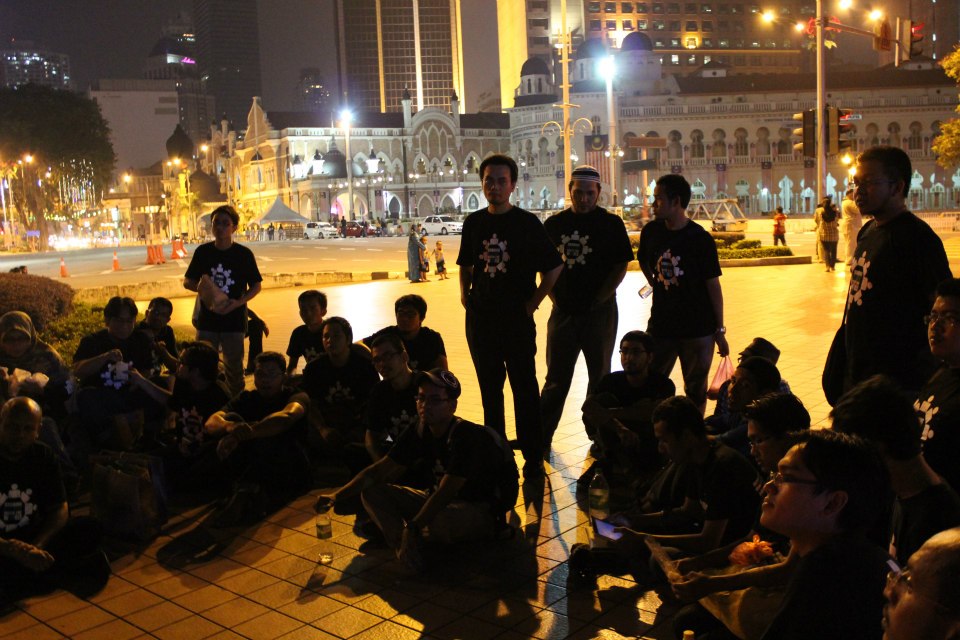
59. You can find some of photos taken during the day of the program below (Credit to beloved friends who uploaded them on Facebook). To end, let me just say this; that in doing dakwah, we either win hearts, or we'll win hard ;-)

Thanks for reading and take care. Wallahuaklam, wassalamualaikum wbt.

Bro Mas Yury: A man with huge commitment and love for dakwah
Bro Saed: Born in Mecca, staying in Malaysia to do his noble part for Islam
Before leaving to several ' hot spots' to share Islam
We occupied Dataran! he3 =)


Read more "Dakwah and Me"

Followers

The Colours of Life

The Colours of Life
Picture taken on Syawal 1, 2009

THE BELOVED FAMILY-Hey, do the maths!

Dad: Mohd Hanaffi bin Hassin
Mom: Noorma bte Mamat

Siblings:

Mohd Ridzwan
Nurul Shuhada
Mohd Amirul Asyraf (blog owner)
Fatihah Sakinah
Nurul Ain Afifah
Ilyana Nazlin
Nur Amira Mawaddah
Mohd Aizat Aiman
Nur Anis
Mohd Amri Afiq